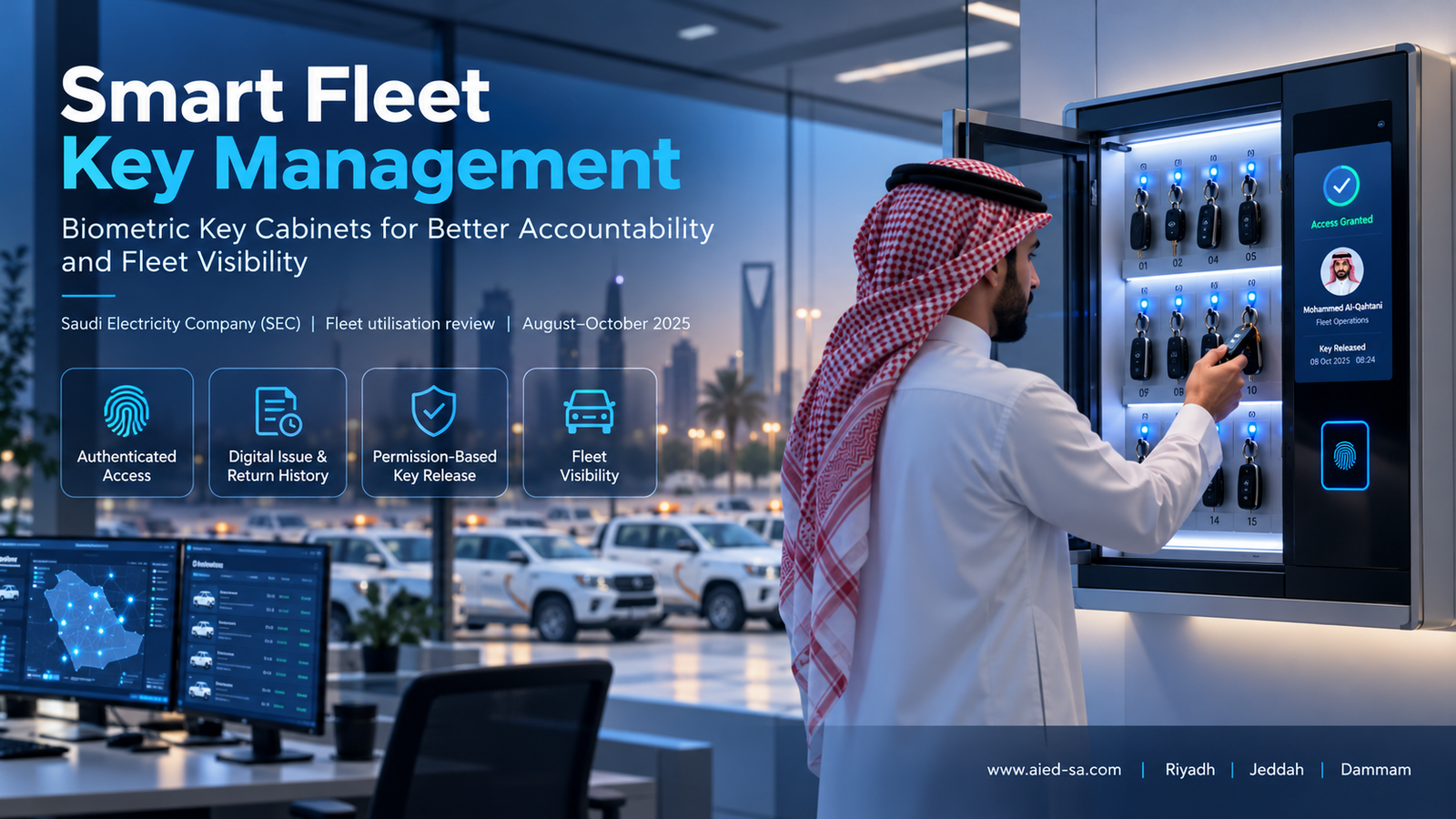
Smart Fleet Key Management with Biometric Key Cabinets: Saudi Electricity Company (SEC)
A practical case study on improving vehicle key accountability, fleet visibility, and data-informed vehicle planning through biometric electronic key cabinets.
Case Study at a Glance
1. Bringing Fleet Key Management into a Connected Digital Workflow
Shared vehicles are an indispensable asset for enterprise field visits, network maintenance, and site-related operations across utility providers. In large-scale operations such as those at Saudi Electricity Company (SEC), keeping shared fleet vehicles ready, secured, and properly accounted for is critical to operational continuity.
When physical vehicle keys are handed over through manual registers, spreadsheets, or informal custody exchanges, verifying who is in possession of a key, when it was taken, and whether it was returned on schedule becomes an uphill operational battle.
To establish full operational control, AIED deployed an intelligent Biometric Electronic Key Cabinet for Saudi Electricity Company (SEC). The solution brings key access, user permissions, and transaction records into a unified digital workflow—replacing loose physical keys with individually locked slots, multi-factor identification, and detailed timestamped audit trails.
2. A More Accountable Way to Manage Shared Vehicles
Managing shared vehicles effectively requires knowing not only where vehicles are driven, but also having strict accountability over the physical keys that authorize access to them. When vehicle keys are left on hooks, in unlocked drawers, or passed directly from one technician to another without recorded checkout, fleet managers lose visibility over availability and usage patterns.
By bringing key access, user permissions, and transaction records into an automated digital process, AIED’s electronic key cabinet enables SEC to maintain an unbroken custody record for every vehicle key. The automated system also creates an actionable data trail that supports data-informed fleet planning, maintenance scheduling, and daily resource allocation.
3. The Challenge: Making Key Handover Easier to Track
Prior to adopting electronic key management, manual or informal handovers created operational blind spots and placed an administrative burden on site dispatchers. Teams frequently spent valuable time searching for misplaced keys, cross-checking hand-written logbooks, or following up when field teams returned vehicles late.
Key operational challenges included:
Limited Key Visibility
Limited real-time visibility into which employee last accessed a vehicle key and where the vehicle is currently deployed.
Wasted Handover Time
Substantial time spent by technicians and desk staff locating misplaced keys, leading to delayed field visits.
Disruption from Late Returns
Subsequent crews delayed or stalled when earlier users failed to return vehicles and keys according to expected schedules.
Limited Incident Audit Trail
Incomplete records for investigating speeding incidents, vehicle damage, fines, or maintenance discrepancies.
Insufficient Fleet Utilisation Data
Without reliable booking and return records, fleet managers had little data to identify under-utilised or over-utilised vehicles, balance pool demand, or plan preventive servicing without impacting field tasks.
SEC required a traceable, enterprise-grade solution that would connect every single key issue and return event to an authorized user, verified via biometric identification, with an exact timestamp.
4. The Solution: Electronic Key Management with Biometric Key Cabinets
AIED deployed an advanced Biometric Electronic Key Cabinet to replace informal key handling with a controlled, digitally recorded process. Each fleet vehicle key is attached to a secure electronic key fob and assigned to a configured slot inside the reinforced cabinet. Mechanical locking mechanisms ensure that only pre-authorized users can release a specific key.
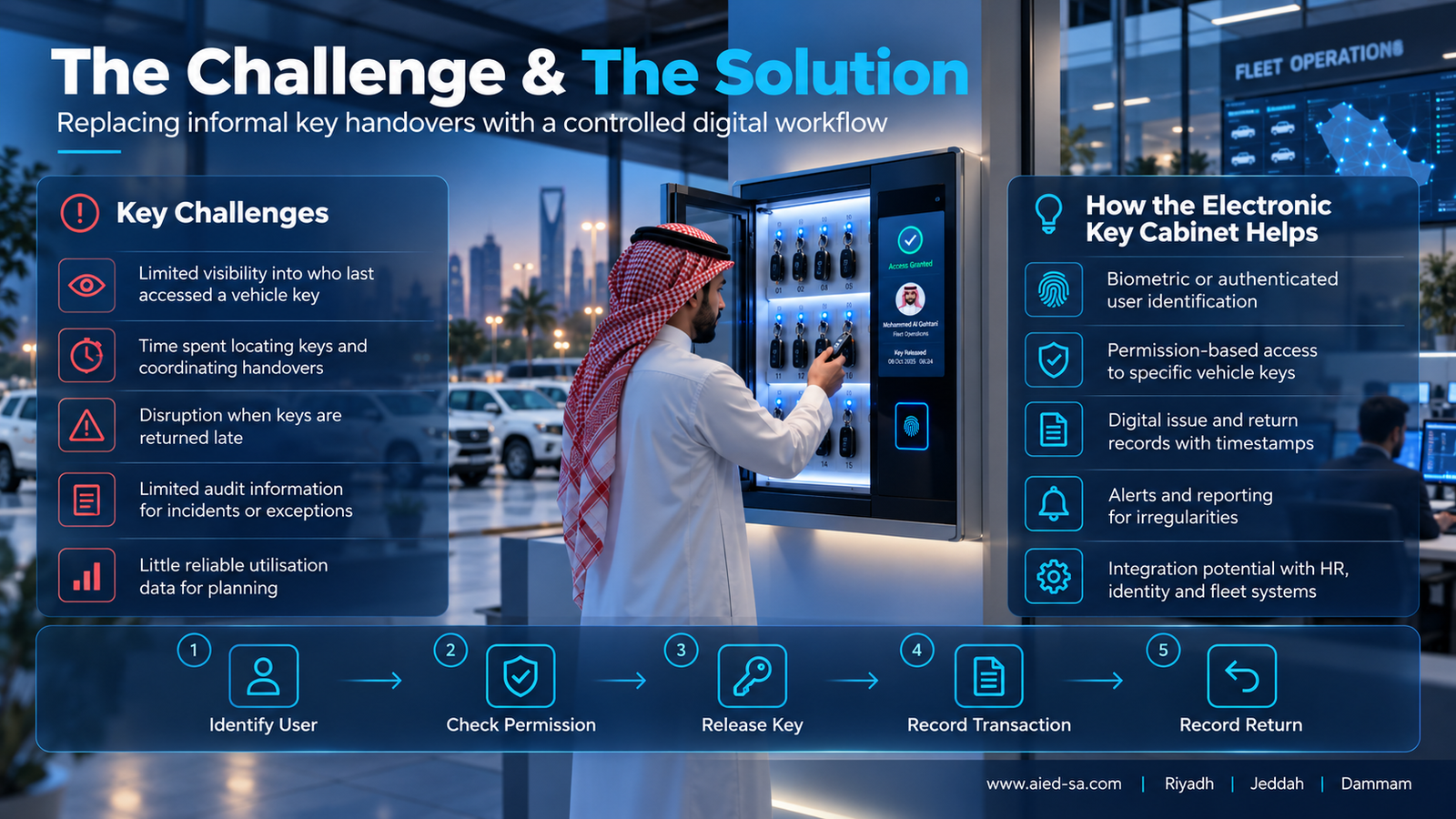
The 5-Step Controlled Fleet Key Handover Process
The automated checkout workflow proceeds across five seamless steps:
- Identify the User: The driver or technician identifies themselves at the cabinet terminal through enabled multi-factor authentication, including biometric fingerprint, facial recognition, RFID staff card, or secure PIN.
- Verify Permissions: The embedded controller instantly validates the user’s role, vehicle authorization profile, active shift status, and driver credential compliance.
- Release the Authorised Key: The cabinet door unlocks, illuminated LED indicators pinpoint the designated key slot, and the specific retention lock releases only the approved vehicle key while all other keys remain locked.
- Record the Transaction: The transaction is digitally stored with the exact employee ID, key identifier, vehicle slot number, and timestamp.
- Record the Return: When field work concludes, the employee authenticates to return the key to its assigned slot; the system verifies successful placement and logs duration and any exception alerts.
5. Key Features That Support Fleet Operations
Individual Key Slots
Each configured slot is mapped to a specific vehicle key with intelligent RFID fobs, locking pins, and optical status indicators.
Permission-Based Access
Drivers and technicians can only release keys matching their assigned role, certification, department, or approved reservation.
Authenticated Transactions
Multi-factor identification methods associate every key issuance and return action unequivocally with a verified user.
Digital Issue & Return History
Centralized digital audit logs make it straightforward for supervisors to review who accessed a key, duration of use, and return timestamps.
Alerts & Exception Reporting
Automated visual and system alerts notify administrators of overdue keys, unauthorized attempts, or extended bookings.
System Integration Potential
Standard RESTful APIs support bi-directional data exchange with enterprise HR systems, active directory identity, and fleet management platforms.
6. Product Overview: Smart Biometric Key Cabinet (26-Key System)
The deployed unit is an enterprise-grade, wall-mounted electronic key management cabinet designed for continuous indoor commercial operation. It incorporates high-grade steel enclosure construction, an intuitive 7-inch Android color touchscreen, and an integrated multi-biometric sensor suite.
| Specification Parameter | Technical Details Stated in Deployment Review |
|---|---|
| Key Capacity | Up to 26 individually secured and monitored key / keyset slots |
| User Interface & Display | 7-inch high-definition Android interactive touchscreen |
| Authentication Methods | Optical fingerprint sensor, facial recognition camera, RFID card reader, and secure PIN pad |
| Network Connectivity | Dual Ethernet (RJ45) and Wi-Fi wireless connectivity |
| System Integration | Open APIs supporting identity, booking, and fleet telemetry integration |
| Alarms & Security | Audible buzzer, visual LED alarms, door tamper sensor, and emergency mechanical override |
| Installation Form Factor | Reinforced wall-mounted enclosure engineered for indoor operational environments |
7. Fleet Utilisation Review: August–October 2025
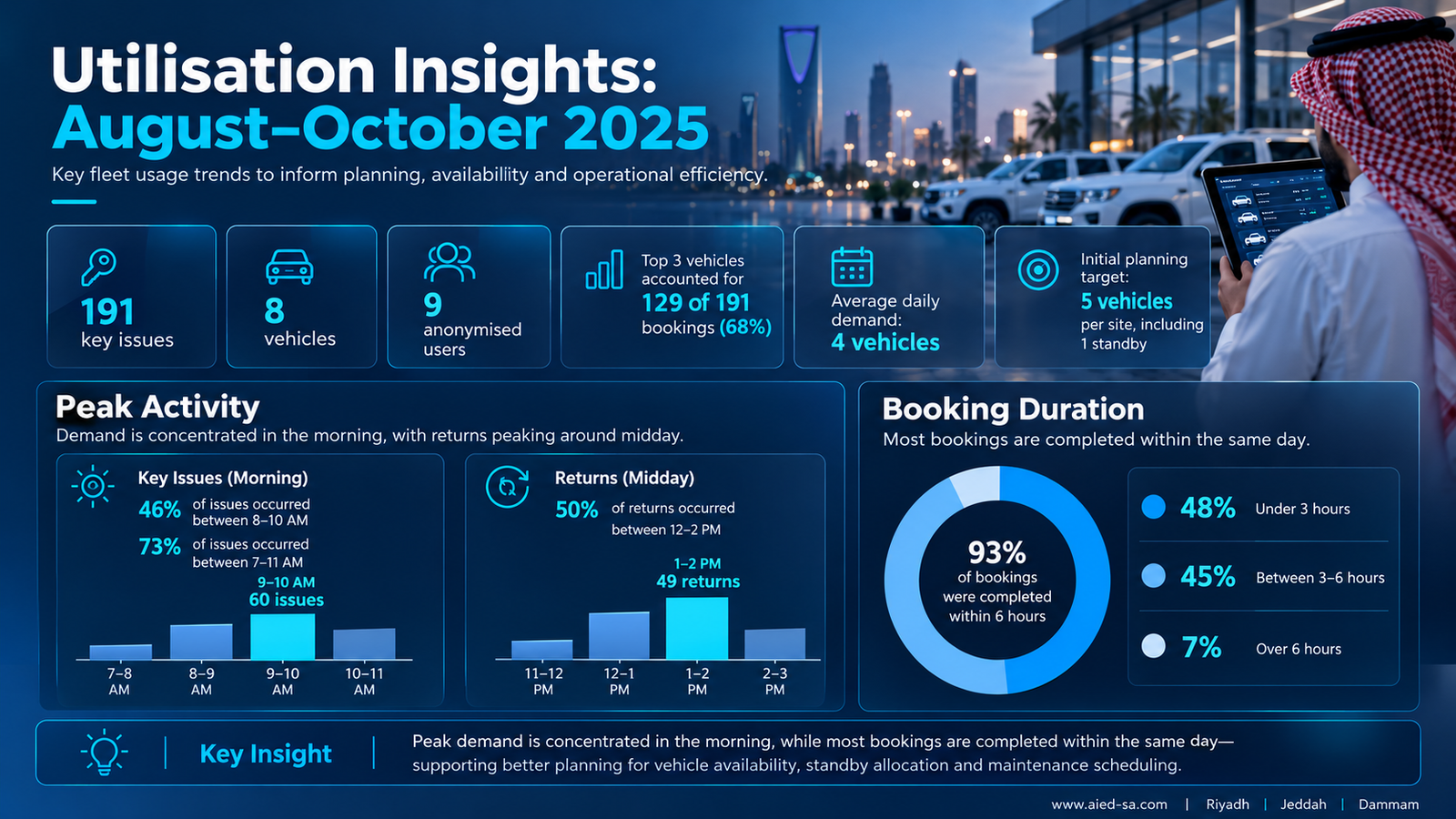
Over a three-month operational evaluation period spanning August through October 2025, the electronic key cabinet recorded a total of 191 key issues across eight shared vehicles and nine anonymized employees (designated U1 through U9). The resulting transaction history provides an objective, data-backed view into vehicle demand distribution, peak operational hours, and user booking behaviors.
8. When Keys Are Issued and Returned
Transaction records reveal a marked concentration of vehicle demand during early morning dispatch, followed by a concentrated return period around midday:
- Morning Issuance Peak: 87 of 191 total key issues (approx. 46%) occurred between 8:00 AM and 10:00 AM. Broadening the window shows that 139 of 191 issues (approx. 73%) took place between 7:00 AM and 11:00 AM.
- Busiest Individual Issue Hour: The peak single hour for vehicle departure is 9:00 AM – 10:00 AM, with 60 key checkouts recorded.
- Midday Return Window: Vehicle check-ins concentrate strongly around lunchtime, with 95 of 191 returns (approx. 50%) completed between 12:00 PM and 2:00 PM.
- Busiest Individual Return Hour: The single peak hour for vehicle return is 1:00 PM – 2:00 PM, with 49 returns logged.
Reported Peak Fleet-Key Activity
Distribution of Key Issue and Return Transactions during Core Operational Hours (SEC Review Period)
Operational Planning Insight: These distinct diurnal rhythms demonstrate that fleet dispatch support and vehicle staging must be fully prepared prior to 8:00 AM. Conversely, routine maintenance, inspections, and vehicle washing should be scheduled outside the primary 8:00 AM – 2:00 PM operating window to prevent vehicle shortages during field service hours.
9. Vehicle and User Demand Analysis
An essential revelation from the review data is the uneven distribution of bookings across available vehicles and personnel:
- Demand Concentration: Just three vehicles—identifiers E01191, E01175, and E01192—accounted for 129 out of the 191 total bookings, representing approximately 68% of all fleet usage.
- Dedicated vs. Shared Patterns: Several vehicles were predominantly used by a single user, suggesting that despite being categorized as shared pool vehicles, they functionally operated as assigned vehicles. In contrast, user U4 demonstrated true pool usage by actively booking across all eight vehicles.
- Data Reconciliation Note: Preliminary reports exhibited slight variance between narrative summaries and tabulated raw booking exports. AIED advises validating vehicle totals against raw logs before making permanent fleet reallocations or decommissioning decisions.
10. Booking Duration and Daily Fleet Demand
Analyzing key checkout duration provides vital intelligence on driver habits and vehicle turnaround:
Short Trips (< 3 Hours)
Rapid site inspections, document deliveries, and local service calls.
Half-Day Trips (3–6 Hours)
Standard work shifts, maintenance rounds, and planned site repairs.
Extended Trips (> 6 Hours)
14 bookings exceeded 6 hours, including 3 lasting over 24 hours.
Overall, 93% of all vehicle bookings conclude within six hours. Across the entire fleet, the average booking duration stood at approximately 3.4 hours. However, notable variances emerged: User U6 averaged 6.30 hours per booking, and User U5 averaged 5.31 hours. Establishing mandatory digital justification and supervisor approvals for bookings projected to exceed 6 hours will ensure vehicle availability for rotating field teams.
Fleet Sizing Benchmark: Average daily fleet demand stabilized at approximately four concurrently active vehicles. AIED recommends establishing an initial planning baseline of five vehicles per site—four active operational vehicles plus one designated standby unit—to maintain resilience during routine servicing and unexpected demand spikes.
11. Business Impact: Better Accountability and Fleet Visibility
Uncompromising Accountability
Biometrically linked issue and return records guarantee that every key movement is tied to a verified employee, eliminating unaccounted keys and manual logbooks.
Enhanced Operational Visibility
Granular transaction data highlights dispatch bottlenecks, peak usage hours, and vehicle dwell times, enabling proactive dispatch coordination.
Data-Informed Fleet Sizing
Objective utilisation metrics allow SEC management to right-size site vehicle pools, eliminate redundant vehicles, and schedule preventive maintenance without field disruption.
Robust Compliance & Audit Trail
Complete historical records protect the organization during traffic penalty attribution, insurance verifications, and corporate safety audits.
12. Recommended Next Steps
To maximize the long-term return on investment from this technology, AIED proposes seven strategic operational enhancements:
- Validate Historical Data: Conduct a comprehensive reconciliation between vehicle-level totals and raw export logs to confirm baseline utilization figures.
- Formalize User Permissions: Review and refine role-based authorization matrices and approval thresholds directly with SEC department leads.
- Integrate Enterprise APIs: Connect the electronic key cabinet platform with SEC's active corporate directory, HR database, and ERP maintenance systems.
- Enforce Pre-Booking Key Release: Restrict key release exclusively to drivers with an active, approved digital reservation in the fleet calendar.
- Establish Monthly Reviews: Launch an executive utilization dashboard reviewed monthly to assess vehicle rotation, idle hours, and driver punctuality.
- Automate Exception Notifications: Configure instant SMS/email alerts for overdue returns, unreturned keys after hours, and extended trip anomalies.
- Adopt a 5-Vehicle Baseline: Standardize on four active operational vehicles plus one designated standby unit per operating facility.
13. Suggested Key Performance Indicators (KPIs)
Key Accountability Rate Target: 100%
Percentage of vehicle key movements tied directly to an authenticated biometric user profile.
On-Time Return Rate Target: > 95%
Proportion of vehicle keys returned within the pre-scheduled reservation window.
Vehicle Utilisation Index Target: Balanced
Monthly operational hours and trip bookings recorded per vehicle across the shared fleet pool.
Peak-Hour Wait Time Target: < 2 Mins
Average time required for field crews to authenticate and retrieve keys during the 8:00–10:00 AM surge.
14. Looking Ahead: From Key Records to Fleet Intelligence
Intelligent electronic key management represents far more than physical key security. When key transaction data is recorded systematically with timestamps and driver identity, it transforms simple hardware records into strategic fleet intelligence.
Through this deployment, AIED has empowered Saudi Electricity Company (SEC) to eliminate informal key custody, enforce driver accountability, and establish actionable data benchmarks for fleet optimization. The next phase will link key cabinets directly into corporate booking portals and predictive maintenance pipelines—paving the way for fully autonomous fleet management.
AIED | Integrated Technology Solutions
AIED specializes in bridging advanced physical security infrastructure with enterprise digital workflows across the Kingdom of Saudi Arabia. From biometric access control and smart key lockers to unified workplace platforms, AIED delivers measurable operational excellence for government, utility, and commercial leaders.
To explore how biometric key management cabinets can secure your vehicle fleet, tools, or high-security facilities, connect with our engineering team in Riyadh, Jeddah, or Dammam.