
AI Camera Analytics & CCTV Video Intelligence in Saudi Arabia
YOUR CAMERAS ALREADY SEE YOUR BUSINESS.
NOW, HELP YOUR BUSINESS UNDERSTAND WHAT THEY SEE.
It is 12:30 in the afternoon. What are your cameras seeing right now?
Your restaurant is busy. Across town, another branch is facing a different problem. Your camera feeds are capturing every second:
Your cameras capture these moments. But your managers may hear about them hours later—through a customer complaint, an end-of-shift report, or a tedious search through recorded footage.
What if the footage could help your team recognise what needs attention while the business is still running?
One Camera Feed. More Business Value.
Most organisations install CCTV to improve security. The same camera infrastructure may also help answer everyday business questions:
Where are customers waiting too long?
Identify bottleneck stages between order placement, kitchen prep, and final counter handover.
Are visible hygiene practices followed consistently?
Ensure gloves, hairnets, masks, and mandatory footwear are consistently worn across shifts.
Which activities take longer than expected?
Measure table turnaround intervals, service staging times, and repetitive workflow friction.
What keeps going wrong at a particular branch?
Benchmark branch indicators against head-office SOPs to spot anomalies and direct management focus.
At AIED, the conversation starts with your operational challenge. We assess your camera environment and identify the supported analytics that could help.
What Is AI Camera Analytics?
AI camera analytics—also called CCTV analytics or AI video analytics—uses computer vision to analyse video feeds and identify selected activities, objects, timings, or events. Depending on the configured solution, this information can be presented through alerts, visual evidence, reports, and dashboards.
Compatible Stream Ingestion
Connects securely to existing compatible RTSP, IP, or NVR camera streams without replacing existing cabling or infrastructure.
Computer Vision Engine
Deep neural networks analyse video frames in real time to detect objects, people, boundaries, trajectories, and protective wear.
Pattern & Event Detection
Calculates dwell durations, service intervals, threshold exceptions, and observable hygiene protocol compliance.
Alerts & Dashboards
Delivers visual evidence clips, instant supervisor alerts, and centralised branch benchmark reports for immediate review.
Three Questions. A Clearer View of Your Operations.
Whether you operate one facility or a network of branches across Saudi Arabia, these questions shape better decisions. Camera-based analytics helps answer them through selected, measurable use cases.
1. What Is Happening?
Receive continuous objective visibility into ongoing activities: customer footfall density, queue formation, prep station compliance, and staff availability in key operational zones.
- Observable physical activities
- Customer queue density
- Live zone occupancy levels
2. Where Does It Need Attention?
Flag threshold breaches and exceptions with exact timestamps and visual snapshots so supervisors can intervene at the specific counter, kitchen, or branch experiencing friction.
- Threshold exception alerts
- Visual timestamped evidence
- Direct supervisor notification
3. What Can We Improve?
Aggregate historical operational data to uncover recurring patterns. Compare multi-branch service durations, optimize shift staffing, and reinforce SOP training where it matters most.
- Multi-location benchmarks
- Shift staffing reallocation
- SOP workflow reinforcement
Measurable Use Cases Built for Your Operations
Explore how AI video analytics bridges everyday questions with actionable evidence across customer-facing and back-of-house operations.
Customer Waiting & Service-Time Analytics
You know the customer experience needs improvement. Yet adding staff may not solve the problem if the delay comes from a slow handover or an inefficient process. Customer waiting-time analytics and service-duration monitoring help you examine selected stages of the customer journey. Review when delays develop, where they recur, and how patterns vary between branches. Use the insight to review staffing, service flow, and operational priorities.
Camera-Based Hygiene & PPE Monitoring
A checklist records an inspection. Everyday operations continue long after that inspection ends. AI video analytics can help monitor the visible use of selected protective items, including gloves, hairnets, masks, and required footwear in designated areas. Potential exceptions can be flagged with relevant evidence for supervisor review. Help your team identify repeated issues, focus training, and reinforce established procedures.
Multi-Location Operational Analytics
A strong branch manager can make a difference. But head office also needs a consistent way to understand what is happening across locations. Bring selected alerts, operational indicators, and trends into a centralised dashboard. Compare recurring issues. Review detected events. Identify where closer attention is needed. Give management a clearer basis for follow-up across the business.
Cleaning & Workflow Analytics
A table stays unavailable. A service area takes longer to prepare. A repeated task runs beyond its expected duration. Individually, these delays may look small. Across a day, they can affect service capacity and customer experience. Camera-based workflow analytics can help track selected observable activities and turnaround intervals. Understand the pattern before deciding how to improve the process.
Evidence-Backed Alerts
When an issue is reported, finding the right footage can become another task. For supported detected events, alerts with timestamps and relevant images help managers review what happened and where. Make investigations more focused and follow-up more specific.
AI Video Analytics for Selected Safety Events
Supervisors cannot watch every area continuously. Monitoring selected PPE practices and supported safety-related events adds another source of information within designated camera-covered zones. Potential concerns can be brought to the responsible team for assessment and action. Support supervision with evidence from the areas that matter to your operation.
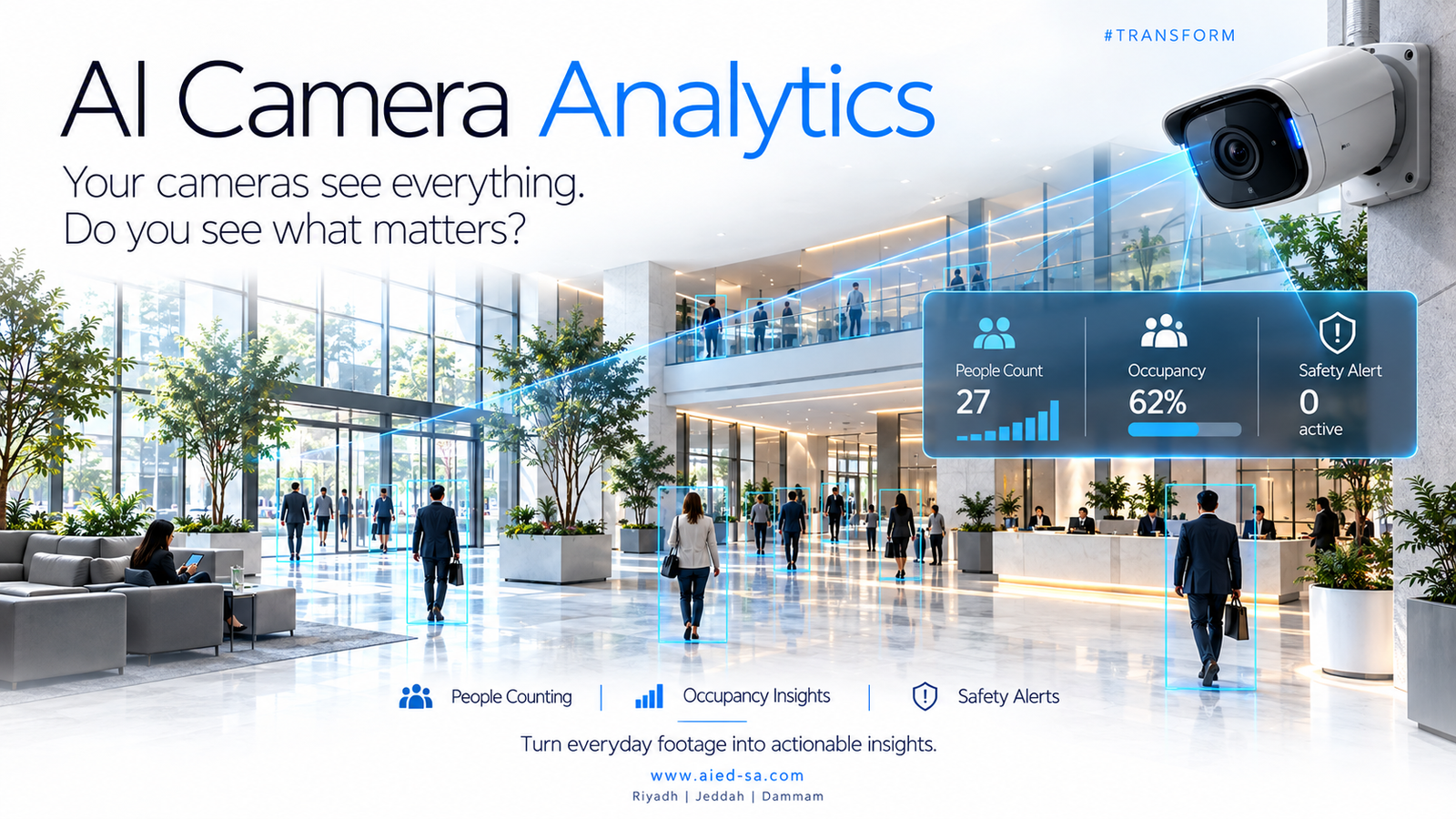
Camera-Based Headcount & People Counting
Camera-based headcount, CCTV people counting, and occupancy analytics concern the number of people detected in a defined area or crossing a configured boundary.
- Understanding entry and exit volumes across busy periods
- Assessing zone density and live occupancy patterns
- Establishing footfall surges by hour, day, and season
Camera-Based Attendance & Employee Identification
Camera-based attendance concerns recording attendance against a specific employee identity. It is different from anonymous people counting. A camera that detects ten people has not necessarily identified ten employees or recorded their attendance.
- How employees will be identified (facial recognition parameters)
- Which camera positions and image quality are required
- How attendance events will be validated and repeat detections handled
- Whether integration with your attendance or HR system is available
- What employee-data and access controls the deployment requires
Built Around the Challenges of Your Industry
From Riyadh hospitality franchises to Eastern Province industrial plants, deploy specialized computer vision workflows engineered around your team's real operational questions.
Restaurants, Cafés & Kitchens
“Are hygiene practices consistent across shifts? Where does customer service slow down?”
Retail Stores & Shopping Centres
“When do checkout queues build? How does customer service vary between locations?”
Food Manufacturing Plants
“Are protective clothing and hygiene practices strictly followed across production shifts?”
Factories & Industrial Facilities
“Which selected safety practices or operating routines need prompt attention?”
Warehouses & Logistics Depots
“Which observable activities are delayed? Where does dock supervision need objective data?”
Hotels & Hospitality Resorts
“Where do front-desk reception, concierge service, or room turnaround delays occur?”
Healthcare & Clinical Facilities
“How can reception, registration, and non-clinical support run more consistently?”
Corporate & Public Centres
“How can we understand visitor service times and space activity in selected areas?”
Your Existing CCTV Could Be the Starting Point
You have already invested in cameras. Before recommending changes, we assess whether compatible feeds can support your selected use case.
Camera positioning matters. Lighting matters. Coverage matters. The activity you want to measure matters.
Camera Positioning & Angles
Reviewing installation height, focal length, angle of incidence, and line of sight to key operational activity zones.
Lighting & Image Quality
Validating ambient illumination, backlighting, shadows, night-time infrared clarity, and shift lighting variations.
Coverage & Field of View
Ensuring clean sightlines without visual blindspots, physical obstructions, or overlapping counting boundaries.
Activity Calibration
Explicitly defining measurable criteria: queue dwell thresholds, PPE checklist items, or turnaround intervals.
Start Small. Measure What Matters.
Choose one location. One operational challenge. One clear success measure. Build the next step around demonstrated results.
1. Focus on One Challenge
Perhaps you want to understand customer waiting times. Perhaps you need better visibility into visible hygiene practices. Or explore camera-based headcount feasibility.
2. Controlled Pilot
A focused assessment and pilot can help confirm what is detectable, how reliable the information is, and whether it improves your team's everyday decisions.
3. Scale with Results
Roll out across multi-location networks using a unified central dashboard with validated operational return on investment and executive visibility.
Frequently Asked Questions
Everything you need to know about AI camera analytics, system compatibility, and rollout in Saudi Arabia.
Can existing CCTV cameras be used for AI video analytics?
What is the difference between CCTV recording and CCTV analytics?
Can CCTV cameras count people?
Is camera-based headcount the same as employee attendance?
Can camera analytics help monitor hygiene?
Can we monitor several branches from one dashboard?
Can camera-based attendance connect to our HR or payroll system?
Where can we discuss AI camera analytics in Saudi Arabia?
Your Cameras Capture the Activity.
Give Your Team a Clearer Understanding.
Discover how AI camera analytics could help you improve visibility into service, hygiene, workflows, and selected safety practices. Exploring CCTV people counting or camera-based attendance? Start with an assessment of the requirement and the available technology.
Request a Technical Assessment
Connect with our computer vision team across Saudi Arabia.